For the ones who have said it today already.
For the ones who said it and knew, as the words were leaving their mouth, that it was not true.
For the ones who have said it so many times it has stopped meaning anything, which is somehow both the problem and the point.
What 'I'm Fine' Is Actually Doing
"I'm fine" is not a report on your internal state. It hasn't been for a long time.
It's a transaction. A way of completing a social exchange without the cost of honesty. A signal that says: I am acknowledging your question and releasing you from any obligation to follow up on it. Both parties understand this. Both parties participate anyway, because the alternative — the honest answer, in most contexts — would take longer than the moment has room for, and would require the other person to be available in a way most people in most contexts aren't.
This is not cynicism. It's just accurate. "I'm fine" is the grease that keeps the social machinery moving. Without it, every "how are you?" becomes a potential appointment. Nobody has the bandwidth for that.
The Cost of Running on It Long-Term
The problem isn't any individual "I'm fine." The problem is what happens after years of them.
Saying you're fine when you aren't requires a specific kind of work. Not dramatic work. Low-grade, constant work: the work of translating what's actually happening into a presentation that other people can receive without being inconvenienced by it. The work of monitoring what's acceptable to surface and what isn't. The work of performing a version of yourself that fits the room.
That work runs on the same reserves as everything else. And it compounds. And eventually, some people find themselves unable to locate what "actually fine" would even feel like — because the performance has been running for so long that the signal underneath it has gotten quiet.
What the Hoodie Is Saying
The I'm Fine hoodie in the Annoying Pleasantries collection isn't ironic exactly. It's more precise than that.
It's taking the phrase out of the context where it functions as a lie and putting it somewhere where that function is visible. Worn on a chest, in public, it can't complete its usual transaction. It's not a response to a question. It's a statement that names the script without performing it.
For the person wearing it: a small private acknowledgment that they know what the phrase is doing. That they've said it a hundred times. That they're not necessarily fine. That they're wearing the language of the performance on the outside of the performance, which is something different than just performing it.
The ones who get it get it without explanation. The ones who don't — see a hoodie that says "I'm fine," which is fine too.
The QR Code Inside
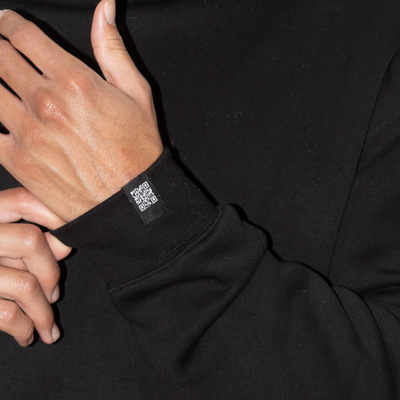
Every UNINSPIRED piece carries a hidden layer — a woven QR code at the wrist that opens an AR reveal when scanned. A message that rotates. Something that exists only between you and the garment.
The reveal inside the I'm Fine hoodie is for the moment after the performance is done. The honest version of the answer. The one you didn't give.
For the ones who are wearing "I'm fine" on the outside while something else runs underneath — that something else is valid. You don't always have to surface it. But it doesn't disappear just because you said you were fine.
The I'm Fine hoodie is part of the Annoying Pleasantries collection. Made-to-order. For the ones who know. Scan the sleeve.