For the ones who drove home and don't remember the last ten minutes of the route.
For the ones who were in the conversation but not really in the conversation.
For the ones who looked in the mirror and felt like they were looking at a stranger — and then felt strange about feeling that way.
This is what dissociation actually feels like. Not the clinical version. The real one.
What Is Dissociation?
Dissociation is a disconnection. Between you and your thoughts. Between you and your body. Between you and the present moment.
It's your nervous system creating distance — from something overwhelming, from a situation that's too much, or sometimes for no obvious reason at all. The brain essentially does what it knows how to do when something is too hard to be fully present for: it steps back.
That stepping back can look like a lot of different things. A fog. A delay. A strange feeling of watching yourself from outside. Moments that pass without you being fully in them.
Dissociation exists on a spectrum — from the mild and mundane to the severe and disruptive. Most people who experience it day to day live somewhere in the middle of that spectrum, in ways that rarely look like what TV shows about mental health portray.
What Day-to-Day Dissociation Actually Feels Like
It's not dramatic. That's the thing most people don't tell you.
It's not blackouts. It's not losing hours. It's not forgetting who you are. For most people, most of the time, it's subtler than that — and because it's subtle, it gets dismissed, explained away, or mistaken for something else entirely.
Here's what it actually tends to feel like:
The fog. You're in a meeting, a conversation, a class. The words are reaching you but they're not landing. You're processing one beat behind everyone else. Responding but not really there.
The glass wall. Everything looks normal but there's a layer of distance between you and it. Like watching your own life through a window. Things that should feel immediate — good news, a touch, a funny moment — arrive muted.
The time skip. You're driving, walking, doing dishes, and a chunk of time has passed that you have no memory of filling. You weren't asleep. You weren't thinking about anything in particular. You were just... elsewhere.
The stranger in the mirror. Derealization and depersonalization are specific kinds of dissociation. Derealization is when the world around you feels unreal — too flat, too sharp, too distant. Depersonalization is when you feel unreal. When you look at your hands and they're technically yours but they feel like someone else's. When you catch your reflection and your face looks like a face, but not your face.
The emotional delay. Something happens — something big — and you feel nothing. Then three days later, driving somewhere completely unrelated, you have the feeling you were supposed to have then. Your emotional processing is just running on a different timeline.
Why It Happens
Dissociation is a protective response. The nervous system learned at some point — maybe early, maybe recently — that full presence in certain situations was dangerous or intolerable. So it built in a buffer.
That buffer is useful when you actually need it. It's less useful when it becomes the default setting. When the nervous system is so used to stepping back that it starts doing it automatically, in situations that don't require it. In conversations that are fine. In moments that are actually good.
This is common with PTSD and complex trauma, with anxiety and depression, with ADHD, with autistic burnout. It's also something that happens to people who don't have any of those diagnoses — people whose nervous systems have simply learned to buffer as a coping pattern.
You didn't choose it. It chose you.
What Makes It Harder
The part that makes dissociation harder than it has to be isn't the dissociation itself. It's what happens around it.
The shame of not being fully present for things that matter. The frustration of people asking if you're okay and not knowing what to say because you don't know the answer. The way it can look from the outside like boredom, or aloofness, or not caring — when the reality is closer to the opposite.
You're not absent because you don't care. You're absent because your nervous system made a call without asking you.
There's also the isolation of it. Dissociation doesn't have a visible symptom. You look like you're in the room. Nobody can see the glass wall from the outside.
Derealization vs. Depersonalization
These terms get used interchangeably but they're different experiences.
Derealization is about the world feeling unreal. Environments look flat or dreamlike. Colors are wrong — too bright or too dull. Spaces that should feel familiar feel like set pieces. The world is there but it feels staged.
Depersonalization is about you feeling unreal. Your body feels like it belongs to someone else. Emotions feel like they're being described to you rather than felt. You're watching yourself perform your own life.
Both can happen together. Both can happen alone. Both are more common than most people realize — and both are significantly underreported because most people who experience them assume they're the only one.
You're not the only one.
The Part Nobody Says Out Loud
Sometimes it's almost peaceful.
That's the part people feel guilty about. When the dissociation is a relief — when the buffer makes a hard thing survivable, when the fog is easier than full presence in something painful.
You're allowed to acknowledge that without it meaning you want to stay there.
Dissociation made sense when it started. It was protection. The fact that it stuck around, that it became a default, isn't a failure. It's just what happens when nervous systems learn something works.
If This Is Familiar
If you've been describing this to people and they don't quite get it — that's not because you're explaining it wrong. It's because dissociation is hard to describe from the outside, and most people haven't had to.
If you've been explaining it to yourself as spaciness, as being tired, as just not being present enough — you might have the wrong word for something you've had for a long time.
This is the right word.
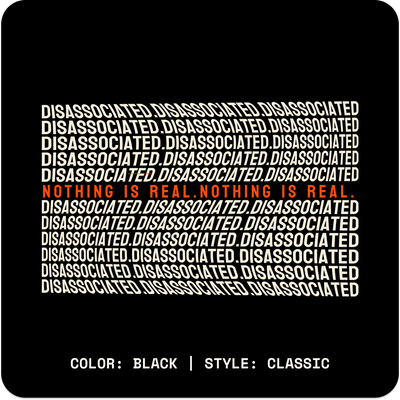
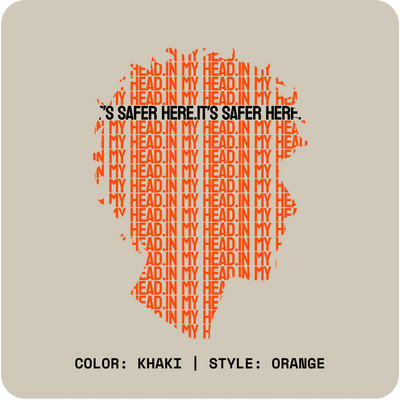
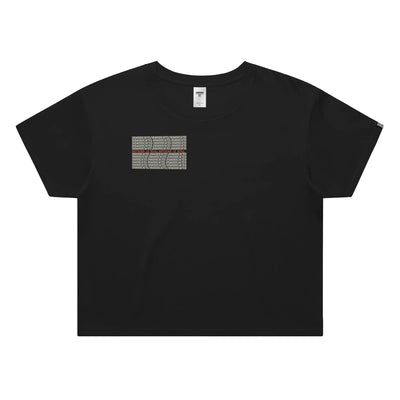
UNINSPIRED makes clothing for the ones who live somewhere between present and not-quite. The Disassociated hoodie doesn't explain it. It just wears it. Scan the sleeve — there's something hidden inside for the ones who know.