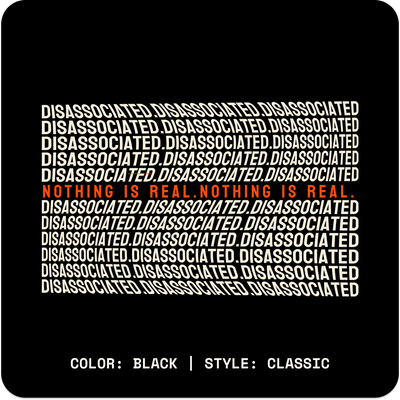
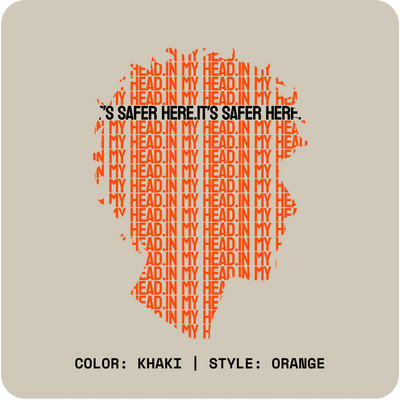
For the ones who've done the work — and still wait for someone to notice they don't belong.
For the ones who rehearse the moment they'll be found out.
For the ones who attribute every win to luck and every loss to proof.
What Imposter Syndrome Actually Is
Not a lack of confidence. Not modesty. Not imposter syndrome meaning you're underqualified — most of the time, you're the opposite. It's the gap. The persistent, exhausting gap between what you've actually done and what you're capable of believing about yourself.
Psychologists Pauline Clance and Suzanne Imes coined the term in 1978, originally studying high-achieving women who — despite every external marker of success — privately believed they were frauds. Decades later, the research shows it affects people across every field, every demographic, every achievement level. The more you accomplish, often, the louder it gets.
That's not a paradox. That's the mechanism. Imposter syndrome feeds on stakes. The higher they are, the more convinced you become that you're about to be exposed.
What It Actually Looks Like Day to Day
It's not always dramatic. Sometimes it's quiet — a reflex so fast you don't catch it until later.
You get a compliment and immediately locate the reason it's wrong. You're passed over for something and it confirms what you already knew. You're given an opportunity and your first thought is: they made a mistake. You prepare more than anyone else in the room — not from diligence, from dread. You attribute success to timing, to luck, to the people around you. You attribute failure to your core.
The internal math is always the same: wins are flukes. Losses are evidence.
You keep a mental file of everything that proves the worst-case theory. Every stumble. Every blank moment. Every time you didn't know something you thought you should. You don't keep the file of everything that disproves it. That evidence doesn't feel real enough to count.
Why High Achievers Get Hit the Hardest
The cruelest part of imposter syndrome is that it scales with accomplishment. The more you do, the more there is to lose. The more visible you become, the more exposure feels imminent.
High achievers often developed early patterns around performance — being praised for results, deriving worth from output, learning that the baseline was excellence and anything less was failure. When that's the foundation, success doesn't feel like evidence of ability. It feels like a standard you're now expected to maintain forever. No room to not know something. No room to struggle publicly. No room to be in process.
So you perform certainty. You perform competence. You stay quiet in meetings where you don't immediately know the answer, then spend an hour afterward replaying it. You over-prepare so no one can catch you underprepared. You shrink your work before anyone else can critique it — preemptively dismissing it to protect yourself from rejection.
It's not that you lack skills. It's that your brain has categorized your skills as something other than real.
Imposter Syndrome vs. Actually Being New
There's a version of this that's situational and temporary — you're genuinely in a new environment, learning a new skill, developing a new competency. That discomfort is appropriate. It's information. It moves.
Imposter syndrome is different. It persists past the point of evidence. You've been doing this for years. You have the track record. You know more than you give yourself credit for — and your brain simply won't update its model.
The distinction matters because "just get more experience" isn't the answer when experience has already piled up and the feeling remains. The problem isn't competence. It's the filter competence passes through.
The Performing Fine Loop
One of the most exhausting features: the performance it demands. You can't admit you don't know something, because admitting that feels like confirming what you secretly believe. So you perform certainty. Then you have to maintain the performance. Then the performance itself becomes evidence that you're a fraud — because you're "faking it."
Round and round. The more you perform, the more fraudulent you feel. The more fraudulent you feel, the harder you perform.
It's not dishonesty. It's survival. When your baseline assumption is that you're about to be found out, performing competence feels like the only option available.
What Makes It Worse
Comparison culture doesn't help. Social media — especially professional spaces — surfaces polished outcomes, not messy processes. You're comparing your internal experience of doubt and struggle to everyone else's external presentation of certainty. The comparison was never fair. It was never apples to apples.
Perfectionism compounds it. When good enough is never good enough, every piece of work becomes an opportunity to find the flaw. The flaw becomes evidence. The evidence feeds the file.
And environments that punish mistakes — even subtly — teach you that not knowing is dangerous. So you hide it. And hiding it makes everything louder.
What Actually Helps
Not affirmations. Not a list of accomplishments taped to your mirror. Those bounce off because imposter syndrome isn't a logic problem — it's a pattern problem. The brain developed the pattern for a reason. Updating it takes more than counter-evidence.
What helps: naming it out loud. Not to perform vulnerability — to interrupt the secrecy. Imposter syndrome survives in isolation. It convinces you that everyone else is certain and you're the only one running this software. You're not. Studies consistently find the majority of high achievers recognize themselves in the description. The pattern is pervasive because the conditions that create it are pervasive.
What helps: separating performance from worth. Not as a philosophical exercise — as a practical daily discipline. You can do excellent work and have a bad day. You can not know something and not be a fraud. You can be in process and not be behind.
What helps: letting things be harder than they should be without making that mean something catastrophic about who you are.
The Statistic You're Not
You are not the one exception. Not the one person in the room who actually doesn't belong. Not the outlier who somehow slipped through every reasonable filter and is now trusted with things they shouldn't be trusted with.
You're someone who learned — somewhere, somehow — that your presence requires constant justification. That doubt is more trustworthy than the evidence. That the worst-case version of yourself is the truest one.
None of that is fact. All of it feels like it. The difference between what you feel and what's true doesn't close overnight. But it starts with noticing the gap exists at all.
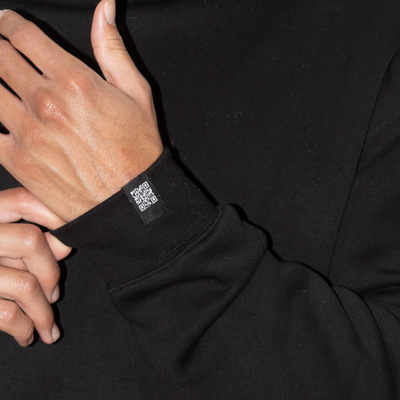
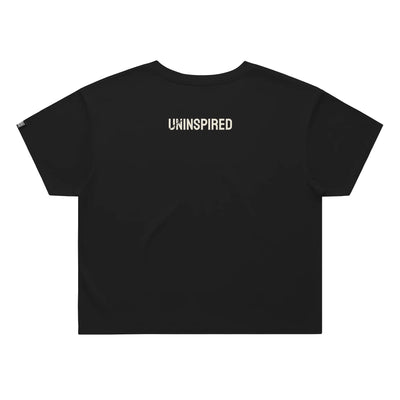
UNINSPIRED makes clothing for the ones who've done everything right and still feel like they're faking it. The Not a Statistic collection is for the ones who refuse to let the doubt write the whole story. Scan the sleeve.