For the ones who have answered "good, you?" more times today than they've actually checked.
For the ones who know the real answer and don't give it to anyone.
For the ones who are tired of the script and don't know what to replace it with.
The Problem With the Question
"How are you?" is the most asked and least answered question in daily social life. It functions, in most contexts, as a greeting — a verbal equivalent of a nod. A way of acknowledging someone without requiring anything from either party. The expected response is "good" or "fine" or "can't complain." Not because those are necessarily true, but because that's the script, and the script keeps the interaction moving.
The question and the expected answer form a ritual. Like much of social ritual, its actual content is not the point. The point is the ritual itself — the mutual acknowledgment, the performance of social smoothness, the demonstration that you're a safe and functional person to interact with. "How are you" means: I see you, I'm acknowledging you, let's proceed. It is not a request for emotional information.
The problem: it sounds exactly like a request for emotional information. The words, taken at face value, ask for an honest account of your current internal state. And most of the time, you have one. You just know that this particular moment, with this particular person, in this particular context, is not where you give it.
What You're Actually Doing When You Answer
Running a very fast social calculation. Reading the person, the context, the stakes. Assessing: is this someone who is actually asking? Do I have the bandwidth to answer honestly? Would an honest answer serve either of us here? Is this a space where something other than "good" is safe?
The calculation runs quickly because you've been doing it for years. The automatic output is "fine" or "good" or some variation. The calculation is below conscious awareness most of the time — until someone asks in a way that makes you pause, or until you catch yourself giving the automatic response to someone who deserved something more and noticing the gap.
The invisible labor in this: you're constantly performing a level of okayness calibrated to the person and context, not to your actual state. That's not dishonesty. That's social competence, correctly applied. The cost is that it becomes automatic to the point where you sometimes give the performance even when you're alone, even when you're checking in with yourself — and the performance is the answer you reach for before you've registered the truth.
The Hierarchy of How Are You
There's a version of "how are you" that means: I genuinely want to know. That's the rarest one. It tends to come from a small number of people in specific, trusted contexts. It has a different quality than the ritual version — slower, with actual eye contact, with a pause that creates space for a real answer. You know the difference when you hear it. Something in you shifts slightly.
There's a version that means: this is a greeting and I'm doing it right. The most common one. Genuine enough in its way — the person does wish you no harm and perhaps broadly wishes you well — but not actually a request for emotional information. The correct response is the script.
There's a version that's genuinely curious but shallow — interested in the social surface, in updates and highlights, in the shareable version of your life. Not seeking the underneath. Also fine. Not every interaction requires depth.
And there's a version that's technically a question but functionally an ice-breaker, a filler, a stall while the person figures out what they actually want to say. The how-are-you with no pause, no wait, no uptick that signals they want an answer. This one isn't asking at all.
The Awkwardness of Honesty
Occasionally, someone gives the honest answer. "Actually, not great" or "it's been a rough week" or "honestly, I'm overwhelmed." In most social contexts, this creates a moment of uncertainty. The person who asked has to navigate whether they're going to engage with what was said, or redirect to something more comfortable.
When they redirect — which happens often — the person who answered honestly is left with something uncomfortable. The confirmation that the question wasn't really a question. The slight exposure of having said something real in a space that wasn't ready for it. The recalibration of their read of the person.
This is why honest answers to how-are-you get calibrated to context over time. You learn where they land and where they don't. And you adjust accordingly. Which is functionally rational — and also a form of managing your own visibility, your own openness, based on what you've learned is safe.
What It Would Take for the Question to Mean Something
A pause after asking. Not moving on immediately. Eye contact that stays. A follow-up if the first answer is "fine" that sounds like: I actually want to know. The willingness to receive something heavier than you expected, without making it awkward or redirecting to comfort.
The capacity to just listen without solving — without offering the thing that will fix it, without making it about your own experience, without moving through the discomfort of someone else's honest state by filling it with advice.
This is not common. It's also not complicated. It requires attentiveness and genuine interest and the tolerance of a few moments of non-comfortable silence. Most people are capable of it. Most people don't do it often enough.
What It Costs to Always Perform
Not much, on any given day. A lot, across a life. The accumulation of interactions where the real answer didn't get to be said. The rooms you've been in where you were less there than you appeared. The chronic low-level gap between your internal state and your social presentation — maintained automatically, at a cost you've stopped noticing.
The antidote isn't refusing to say "fine." It's finding the places, and the people, where something else is possible. And being, occasionally, the person who asks in a way that means it.
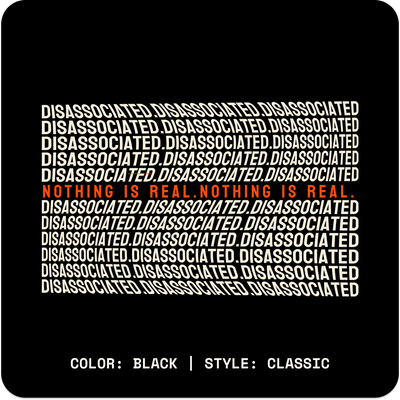
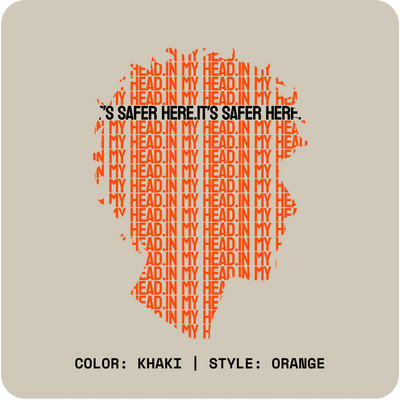
UNINSPIRED makes clothing for the ones who know what they're actually saying when they answer. The How Are You collection is for the ones fluent in the question nobody actually wants answered. Scan the sleeve.