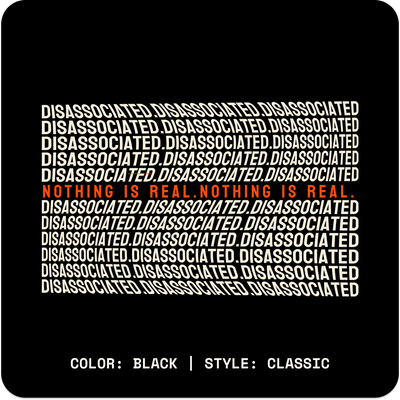
For the ones who have been told to look on the bright side so many times they started to wonder if the dark side was real.
For the ones who said "I'm struggling" and got back "but think of all the good things" — and felt worse.
For the ones who learned to distrust their own read on situations because the people around them kept offering a different one.
What Gaslighting Actually Is
Gaslighting is when someone causes you to doubt your own perception of reality. The term comes from a 1944 film, but the dynamic it describes is old and common: one person's interpretation of events is consistently treated as the correct one, and the other person's is consistently dismissed, reframed, or contradicted until they stop trusting themselves.
Most people understand gaslighting as something one person does to another. What gets less attention is how the same mechanism can run internally — when you've internalized the dismissal so thoroughly that you do it to yourself.
Where Toxic Positivity Comes In
Toxic positivity is the insistence that a positive frame is always available and always preferable — and that the failure to adopt it is a personal failing.
It sounds like:
- Everything happens for a reason.
- You just have to choose happiness.
- Others have it worse.
- Focus on the good.
- Don't let negativity in.
None of these statements are necessarily false. Some of them are occasionally useful. The problem is their function — which is to cut off the legitimate acknowledgment of a difficult experience before it's been allowed to exist.
When this is applied consistently — by the culture, by the people around you, by the internal voice you developed in response to both — it trains you to override your own experience in real time.
That's the gaslighting mechanism. Not malicious, necessarily. But functionally identical in outcome: you stop trusting what you feel.
What Self-Gaslighting Looks Like in Practice
It doesn't feel like lying to yourself. It feels like being reasonable.
Something happens that genuinely affects you. Before the feeling fully registers, a second voice arrives: It's not that bad. You're overreacting. Other people handle this fine. You should be grateful. Stop being so sensitive.
The feeling gets compressed before it's been processed. You perform okay. You tell people you're fine.
And then you don't know why everything is harder than it should be, why you feel vaguely disconnected from your own life, why something minor can suddenly bring you completely undone — because you've been suppressing a backlog of experience you were taught not to validate.
This is what chronic toxic positivity produces. Not resilience. A growing gap between what you feel and what you allow yourself to know you feel.
The Difference Between Reframing and Dismissing
Reframing is real. Finding meaning in hard things is real. Choosing where to put your attention has genuine value.
The difference is sequence.
Reframing that comes after acknowledgment is useful. It's what happens when you've let a thing be real, felt it fully, and then asked: what else is true here?
Toxic positivity runs the reframe instead of the acknowledgment. It skips the part where the experience is allowed to exist and jumps straight to the lesson, the silver lining, the redirect.
What gets lost in that skip is trust — trust in your own read on your own life.
Why It's So Hard to Identify
Because it's been framed as virtue.
Optimism is good. Gratitude is good. Resilience is good. The cultural packaging around toxic positivity borrows the language of all three and uses it to enforce a kind of emotional compliance. If you're not positive, you're negative. If you're negative, you're the problem.
And if the people who were supposed to model emotional authenticity for you were themselves running on performed positivity — if the message from early on was that difficult feelings were burdens that made you hard to be around — then the internal gaslighting voice didn't arrive as a foreign presence. It arrived as wisdom.
Unlearning it doesn't mean becoming negative. It means learning to ask: what am I actually feeling right now, and does it make sense given what actually happened?
Most of the time, the answer is yes. The feeling makes sense. It was always going to.
For the ones who were taught that the bright side was the only side worth looking at — the other side is real. It was always real. You just weren't allowed to look at it.
UNINSPIRED makes clothing for the ones who are done performing fine. Shop the Annoying Pleasantries collection. Scan the sleeve.