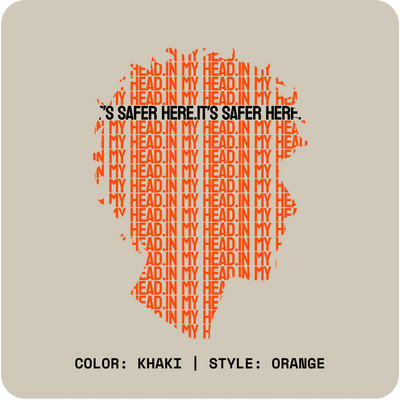
For the ones who look at a room they know well and feel like they've never been there before.
For the ones who watch their own hands and find them unconvincing.
For the ones who are physically present and somewhere else entirely, simultaneously.
What Derealization Is
Derealization is an altered state of perception in which the external world — the environment around you, the people in it, the physical space you inhabit — feels unreal, distant, foggy, or dreamlike. You know, on some level, that what you're experiencing is the real world. But it doesn't feel real. There's a film over everything. A lag. A quality of watching rather than being inside.
It's different from delusion or psychosis: you're not believing something false. You're experiencing a perceptual shift that makes the real world feel wrong, without any change in your understanding of what's real. That combination — knowing something is real, experiencing it as unreal — is part of what makes derealization so disorienting to describe and so unnerving to be inside.
Derealization often occurs alongside depersonalization — a sense that you yourself are unreal, detached from your body, watching yourself from outside. Together, they fall under the category of dissociative experiences: the mind's way of creating distance from an experience that feels too large, too threatening, or too overwhelming to process directly.
What It Looks Like
The world looks two-dimensional, or flat, or artificially lit. Familiar places feel foreign. People you know well seem unfamiliar, like strangers who happen to look like someone you love. Sounds feel distant or muffled. Colors look different — either unusually vivid or strangely washed out. Time moves strangely: too fast, too slow, or in a way you can't account for.
You might feel like you're watching your own life on a screen. Or like there's a glass wall between you and everything else. Or like you stepped into a very convincing simulation of your normal life and there's something just slightly off that you can't locate.
The experience can last seconds or minutes. Or it can persist for hours, days, or longer — sometimes fluctuating in intensity. For some people it's occasional and clearly tied to anxiety or stress. For others it's more chronic — a background quality to their experience of reality that ebbs and flows but never fully lifts.
Why It Happens
Derealization is most commonly associated with anxiety and panic disorders, trauma and PTSD, sleep deprivation, and significant stress. It can also be triggered by certain substances, and it can occur without a clear trigger at all.
At its root: a nervous system response. When the brain encounters something it registers as overwhelming — emotionally, cognitively, sensorially — one possible response is to create perceptual distance. The philosophical term is derealization. The functional explanation is: your nervous system is trying to protect you from full contact with something it has assessed as too much. The dissociation is the buffer.
For people with anxiety, derealization often gets triggered by the anxiety itself — which creates a feedback loop. The derealization is disorienting, which creates more anxiety, which deepens the derealization. This is particularly common during or after panic attacks. The heightened arousal of panic can shift perception in ways that persist even as the acute panic subsides.
Derealization vs. Depersonalization
These two often get conflated because they frequently co-occur, but the distinction is meaningful. Derealization is about the external world feeling unreal. Depersonalization is about your internal experience — feeling detached from your own thoughts, body, emotions, or sense of self. One is "the world feels like a dream." The other is "I feel like a dream."
In practice: derealization might mean looking at a room and feeling like it's a set. Depersonalization might mean looking at your hands and feeling like they belong to someone else. Both involve disconnection — one outward, one inward.
The Fear of Going Crazy
One of the most consistent features of derealization: the fear that it means something is very wrong. That you're losing your grip on reality. That it's a sign of something serious, something permanent, something you can't come back from.
That fear is itself a significant driver of the experience. The more afraid you are of the derealization, the more your nervous system stays in the activated state that produces it. It's one of those experiences that gets worse the harder you try to fight it or fix it in the moment.
What's worth knowing: derealization is extremely common. Research suggests the majority of people will experience it at some point in their lives, most commonly in the context of high stress or anxiety. It's distressing. It's disorienting. It is not a sign of psychosis. It is not evidence that you're losing your mind. It's a perceptual response — an automatic one, often — that your nervous system is capable of generating under the right conditions.
What Helps
Grounding. Specifically, sensory grounding — directing attention back to physical sensation in the present moment. Cold water. Texture. Sound. Not to force yourself out of the derealization, but to give the nervous system real sensory input to anchor to. Something concrete in the present moment, while the perceived world feels unreal.
Reducing the anxiety response to the derealization itself. The derealization is not dangerous. Naming it when it happens — "this is derealization, my nervous system is doing a thing" — without attaching a catastrophic narrative to it. Not fighting it. Not feeding it with panic. Letting it be what it is, and waiting for the nervous system to regulate back down.
For chronic or persistent derealization: professional support is worth seeking. Particularly with a trauma-informed or dissociation-literate therapist. The experience has treatment options — it doesn't just have to be endured.
UNINSPIRED makes clothing for the ones who know what it's like to be somewhere and nowhere at the same time. The Disassociated collection is for the ones whose mind learned to leave before the body could. Scan the sleeve.