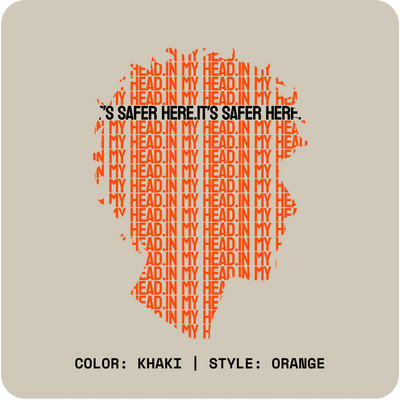
For the ones who've looked at a familiar room and felt like they were looking at a stage set.
For the ones who've caught their reflection and recognized the face without feeling like it was theirs.
For the ones who've tried to explain this to someone and watched them not quite understand.
Two Experiences With One Root
Derealization and depersonalization are both forms of dissociation — experiences of disconnection that the nervous system produces, usually in response to overwhelming stress or as a protective pattern that has become habitual.
They're related but distinct, and understanding the difference matters for naming what you're actually experiencing.
What Derealization Is
Derealization is the experience of the external world feeling unreal.
Not scary, necessarily — just wrong. Off. Familiar places look flat or dreamlike. Colors may seem too bright or too dull. The proportions of spaces feel slightly incorrect. Things that should feel immediate and solid feel instead like they're behind glass, or like a very good reproduction of what they should be rather than the actual thing.
It's often described as feeling like you're inside a movie, or a dream you can't wake from, or a very convincing simulation. The world is there. It's functioning. You can interact with it. But the sense of it being real — the felt certainty that this is actual reality — has become unstable.
Common derealization experiences:
Familiar environments suddenly feeling unfamiliar. Spaces you've been in hundreds of times feeling strange and new, or staged. The feeling of walking through a place you've been before that has somehow become a replica of itself.
Perceptual distortions. Things looking slightly too small or too large. Depth perception feeling off. The visual field looking flat or two-dimensional.
The sense of unreality after intense stress, poor sleep, or in crowded or sensory-overloading environments.
What Depersonalization Is
Depersonalization is the experience of yourself feeling unreal — or of watching yourself from outside yourself.
Where derealization is about the world, depersonalization is about you. Your body feels like it belongs to someone else, or like you're operating it remotely. Your emotions feel like they're being described to you rather than felt. You watch yourself do things — speak, move, make decisions — as if you're an observer rather than the person doing them.
Common depersonalization experiences:
Watching yourself from outside your body. The sensation of seeing yourself from above, or from a slight distance behind yourself. Feeling like a spectator of your own life.
Emotional numbness paired with awareness. Knowing what you should feel without feeling it. The gap between what the situation calls for and what you're actually experiencing.
Hands and face feeling strange. Looking at your hands and registering them as yours technically but experiencing them as slightly disconnected from you. Catching your reflection and seeing your face without the usual sense of recognition.
Why They Happen
Both derealization and depersonalization are protective responses — the nervous system creating distance from something overwhelming. They're most common in:
Anxiety and panic. During intense anxiety, the nervous system can produce dissociative symptoms as part of the stress response. This is extremely common during panic attacks.
Trauma and PTSD. The nervous system learned early that full presence in certain situations was dangerous, and built in a buffer. That buffer generalizes.
Sleep deprivation. Derealization and mild depersonalization are near-universal in states of significant sleep deprivation — one of the reasons the experience is familiar to most people even if they don't have a clinical presentation.
Cannabis. Depersonalization and derealization are among the most commonly reported effects of cannabis, particularly at high doses or in people with underlying anxiety.
Depression and burnout. The flatness and disconnection of both can include dissociative features.
How Common Is This?
More common than most people realize. Studies suggest around 50% of adults experience at least one episode of significant derealization or depersonalization in their lifetime. Depersonalization-Derealization Disorder — where these experiences are chronic and significantly impairing — is estimated to affect around 2% of the population.
The experience itself is much more prevalent than the disorder. Most people who experience derealization or depersonalization don't have a dissociative disorder — they have a nervous system that occasionally does what nervous systems do under stress.
For the ones who've been trying to describe this to people and finding that the language doesn't quite cover it — the language exists now. You're not imagining it. You're not the only one. And you're not looking for something that isn't there.
UNINSPIRED makes clothing for the ones who live somewhere between present and elsewhere. The Disassociated hoodie wears the thing. Scan the sleeve — there's more inside.